PSMA PET/CTs may be in your Gleason 6 futures yet--replacing biopsies
Reduce your inflammation in a study for low-riskers-see below

(Editor’s note: I will be covering AS news for the next few days at the European Association of Urology (EAU) 2026 Congress in London. I will be writing about sessions remotely to keep you and me up to date. This is the first time The Active Surveillor has been formally accepted for a press pass. Previously, I’ve covered this meeting for another news outlet. So I may be publishing more frequently. I know some of you prefer news less often. No worries. This is for those of you who have told me you want as much news as you can get.—HW.)
By Howard Wolinsky, Editor, The Active Surveillor
Patients with low-risk prostate cancer ask all the time at webinars if they could skip a biopsy and just have a PSMA PET/CT.
The answer in the U.S. and elsewhere is usually “no” or “not yet.”
But a new Australian study, PRIMARY2, presented last week at the European Association of Urology (EAU 26) Congress in London, showed that PSMA PET/CT, essentially the same as a PSMA PET, might eventually become a significant way to avoid prostate biopsies and their side effects, such as sepsis and overuse of antibiotics that lead to antibiotic resistance.
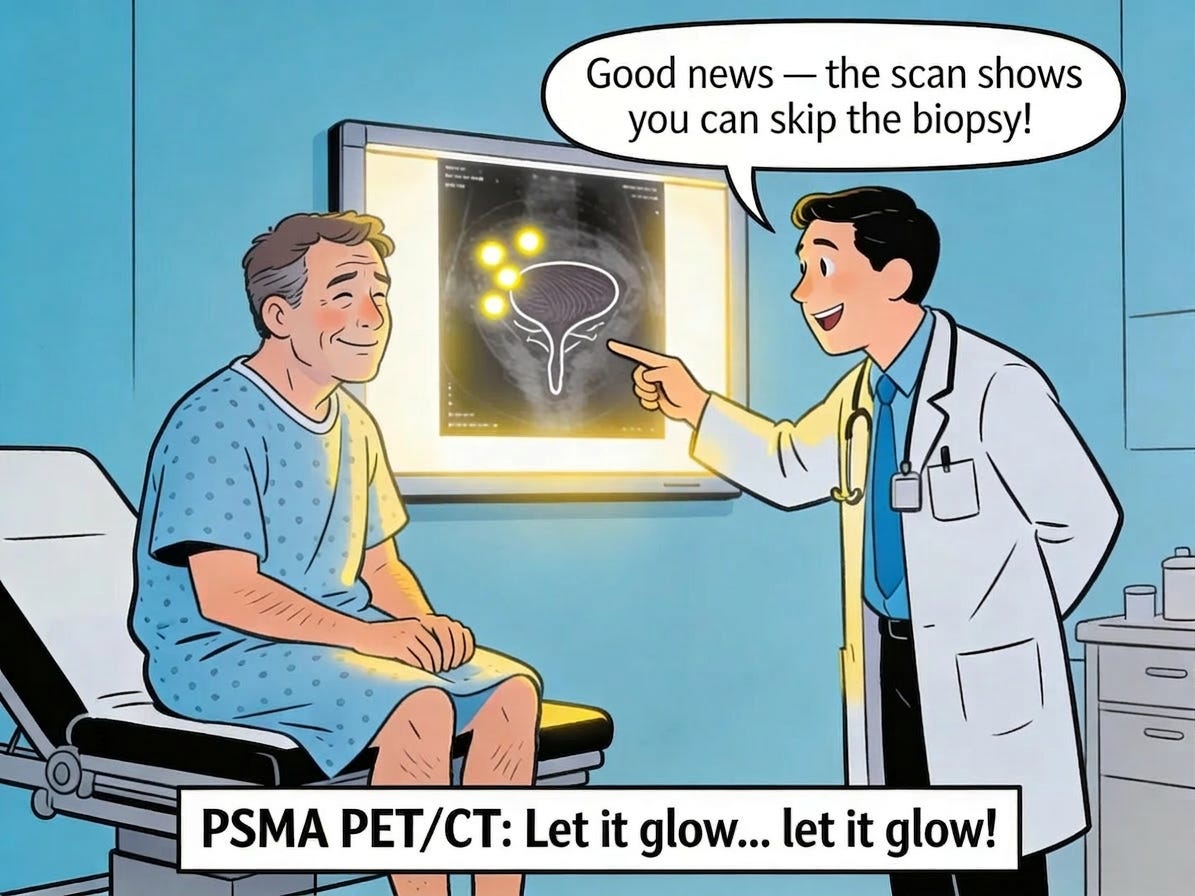
(Perplexity/The Active Surveillor)
[PSMA PET/CT combines the PET scan with a simultaneous CT (computed tomography) scan. The CT provides detailed anatomical structure — bones, lymph nodes, organs — while the PET highlights cancer activity. The two image sets are then fused together, giving physicians both where the cancer is metabolically active and exactly the anatomy to which it corresponds.)]
Why the Combo Matters
In practice, nearly all PSMA PET scans performed clinically are done on a combined PET/CT machine, which is why the terms get used interchangeably.
PSMA PET/CT is a special nuclear scan that makes prostate cancer cells literally “light up” and could safely cut the number of men who need a biopsy in half — and researchers say it may one day replace routine biopsies altogether for many patients.
Results from the PRIMARY2 trial show that a PSMA PET/CT scan used after a normal or inconclusive MRI halved biopsy rates — without missing a single aggressive cancer.
How the Scan Works
A safe radioactive tracer is injected and travels through the body, locking onto prostate cancer cells and making them “glow” as bright spots on the image. More aggressive cancers light up intensely; slow-growing, low-risk cancers may not appear at all — meaning those men could safely skip the biopsy entirely.
Dr. James Buteau, a nuclear medicine physician at Peter MacCallum Cancer Centre in Melbourne, who presented the study, said: “PSMA PET/CT scanning makes prostate cancer cells light up in a remarkable way, particularly in more aggressive cancers. It’s rare to see such strong imaging that could be so powerful in the clinic. Incorporating this testing into clinical care could help to address the major challenge of prostate cancer overdiagnosis, which leads to at best unnecessary and at worst harmful treatment for cancers that would never cause any harm.”
The PRIMARY2 Results
The trial enrolled 660 patients across Australia — men with higher-risk factors (rising PSA, strong family history) but normal or borderline MRI results (PI-RADS 2 or 3)— lower-risk lesions.
Under the standard approach, 44% of biopsies found no cancer and 32% found only a slow-growing cancer needing no treatment. With PSMA PET/CT guiding decisions, those numbers dropped to 22% and 14%, respectively.
Co-lead researcher Prof. Louise Emmett of St. Vincent’s Hospital in Sydney said: “Getting told you have a risk of prostate cancer is a huge cause of anxiety and concern. Our findings show that PSMA PET/CT after MRI offers a ‘belt and braces’ approach that can determine which people have a clinically significant cancer, and which people are at low risk and don’t need a biopsy or further testing.”
Prof. Derya Tilki, of the Martini-Klinik Prostate Cancer Center in Germany, called it “a well-conducted trial” that “significantly reduced the number of unnecessary biopsies and the diagnosis of clinically insignificant prostate cancer” — and crucially, “this didn’t compromise the detection of clinically significant disease.”
Could It Replace Biopsies?
That’s the direction the science is heading. For men with a suspicious scan result, PSMA PET/CT also pinpoints the exact location — allowing a more precise, targeted biopsy with fewer complications. These are the first results from PRIMARY2; the trial will follow all 660 patients for two years, and the findings were simultaneously published in The Lancet Oncology.
What About Active Surveillance Patients?
For now, PSMA PET/CT is mainly approved for men with intermediate-to-high-risk disease or cancer recurrence.
In Australia, Medicare, the national health program, covers the scans only for those cases; Gleason 6 / low-risk patients on Active Surveillance are not yet covered and would pay roughly $1,000 AUD out of pocket. The ongoing CONFIRM trial is specifically testing whether PSMA PET/CT can improve risk stratification for AS patients — expanded coverage may follow if results are strong.
In the U.S., the FDA has approved two PSMA tracers (Ga-68 PSMA-11 and PYLARIFY), and more than 350,000 PSMA PET scans were performed in 2024 — up over 30% from the prior year. U.S. Medicare patients face a co-pay. Without insurance, costs can reach $5,000–$11,000. Most of the cost is for the tracer. Pre-authorization is essential.
Quick Safety Note
PSMA PET/CT is considered very safe. Radiation exposure (~4–7 mSv/millisievert — a unit used to measure radiation dose absorbed by the human body, specifically its biological effect) is actually less than a standard abdominal CT scan. Side effects are usually mild — brief fatigue, headache, or minor injection-site soreness. Rarely, a mild allergic reaction can occur. One practical tip: if you’re flying within 24 hours of the scan, carry a doctor’s note — the tracer can trigger airport radiation detectors.
Check out Richard Maye’s first-person article on his PSMA PET test:
Previous report on Down Under:
Putting the Active into Active Surveillance, taking the inflammation out of your lifestyle
AnCan is hosting a free, drop-in survivorship seminar on Wednesday, April 1 at 7 PM Eastern, just before their regular AS support group session. The free session will be at AnCan Barniskis Room.
Drs. Rob Rutledge and Gabriela Ilie, the team behind PCPEP — the Prostate Cancer Patient Empowerment Program (pcpep.org), will be presenting a program, “Active Surveillance: The Science and Practice of an Anti-Inflammatory Lifestyle.”
The Canadian researchers, based at Dalhousie University in Halifax, will discuss a study for which they are enrolling AS patients.
Rutledge said: “The premise is straightforward and compelling: men on Active Surveillance consistently ask, ‘What can I do? PCPEP answers that question with science.”
The free evidence-based, six-month program delivers a short daily video (about 5 minutes) covering diet, exercise, sleep, stress management, and more — all aimed at lowering inflammation and strengthening immunity. Their clinical trial is now entering Stage 4, and they are actively seeking US-based men on initial Active Surveillance.
Rutledge said: “Learn how stress reduction, exercise, nutrition, better sleep, and positive social connection can influence inflammation and support prostate health.”
When discussing the PSMA PET Scan it may be of value to mention the rating of the scan or the SUV Standard Uptake Value. A score of 11 or more can indicate aggressive cancer. My highest score was 8.3 well below the average high end of 11.
The key question AnCan asks is whether GG1 and GG2 prostate cancer cells produce PSMA? If not, then the PSMA scan will be negative, and you may skip a Bx. That's OK for GG1, but what about GG2?