Looking back on Active Surveillance 2025: Evolution, revolution, and unfinished business.
Happy 2026. Join my webinar AS '26 on Jan. 3--20 free tickets to attend.
By Howard Wolinsky
If 2025 had a theme in Active Surveillance for prostate cancer care, it was this: the tools are finally catching up to the philosophy.
After decades of overtreatment, the movement toward Active Surveillance (AS) gained a serious technological backbone—yet stubborn debates remind us that progress is rarely linear.
As someone who, in 2026, will mark his Sweet 16th on surveillance, I’ve watched this evolution from the trenches as both a patient and a medical journalist. Here’s what changed, what didn’t, and what it means for the 3.5 million American men living with a prostate cancer diagnosis. This includes up to 320,000 AS-eligible with Gleason 6. (Grade Group 1) and another 90,000 with AS-eligible favorable intermediate-risk Gleason 3+4 (Grade Group 2).
The biggest story of 2025? Keeping those nasty needles out of our business.
I think it is that we’re learning how to monitor men without repeatedly sticking needles where they don’t belong.
The “Holy Grail” I’ve been waiting for, a blood test that could replace confirmatory surveillance biopsies, finally showed real promise in 2025.
The new assay, MyProstateScore2-AS, analyzes circulating biomarkers to detect molecular progression, potentially sparing men the risk of infection and the anxiety and other emotional distress associated with random biopsies.
Early data suggests MPS2-AS from Lynx DX could identify the 15-20% of AS patients who genuinely need intervention while letting the rest avoid biopsies.
That’s not just convenience; it’s a potential game-changer for compliance and quality of life, avoiding risks of infections, including potentially disabling and deadly sepsis.
More research is needed to confirm this. So the test is not yet in the market.
In 2025, biopsies themselves have gotten smarter with MRI-guided targeting that limits the number of cores needed—and there are suggestions that biopsies—especially “random” ones—may disappear altogether.
Dr. Laurence Klotz, the godfather of AS, has made waves by declaring that random biopsies “should be retired.”
And Dr. Mark Emberton, a urologic oncologist at University College London, is going bigger, arguing that a combination of MRIs and PSMA (prostate-specific membrance antigen), usually a PSMA PET/CT, an advanced imaging test that uses a radioactive tracer to find prostate cancer cells anywhere in the body, could help get rid of biopsies.

(Art by Perplexity AI and The Active Surveillor.)
His argument: in the MRI era, systematic 12-core sampling finds mostly insignificant cancers while missing the ones that matter. The data support him. At my 15-year mark, I had a biparametric MRI that enabled me to avoid a prostate biopsy—as I have for a decade.
(Active Surveillance Patients International is scheduled to present a program on the topic featuring Emberton in February. Details TK.)
Old habits die hard. US urologists still perform a million or so of these procedures annually.
Progress is being made. However, the uptake of prebiopsy MRI in the US lags: fewer than 30% of American men undergo these biopsies, compared to 75% in the UK.
Imaging Wars: David vs. Goliath
If random biopsies are disappearing, imaging and AI are the future—and 2025 brought a David to challenge MRI’s Goliath status. [
Micro-ultrasound, an inexpensive, US Medicare-covered technology that uses high-frequency sound waves to create real-time 3D prostate maps, has been shown to be equivalent to MRI in detecting clinically significant cancer. I covered the European Association of Urology meeting, where researchers, including Klotz, presented head-to-head data showing micro-ultrasound caught just as many significant tumors while being cheaper, faster, and more portable. For men in rural areas or countries where MRI access is limited, this could democratize precision diagnosis.
I have been following micro-ultrasound for almost a decade and am pleased to see its progress—but will the hospitals that need to keep feeding their expensive MRI machines allow this cheap technology to take hold?
MRI itself got both simpler and faster in 2025. Bi-parametric MRI proved just as accurate as multiparametric MRIs with gadolinium, eliminating Gd contrast (a relief for men worried about brain deposits) and reducing claustrophobia. The contrast “elephant in the tube” is finally being addressed.
And the Active Surveillor even learned—too late—in 2025 that enemas before prostate MRIs are unnecessary. After decades of uncomfortable prep, researchers have shown that enema reduced stool and gas but did not improve image quality or reduce motion/blur/distortion artifacts or corrupted data.
Sometimes the smallest changes make the biggest difference in patient experience.
AI is now in the MRI mix
2025 was the year for AI and MRIs as was 2024 for AI for pathology reads.
An AS patient told readers that four different radiologists assigned four different PI-RADS scores to the same MRI. He wanted to use AI as a tie-breaker.
When you’re making life-altering decisions based on one scan, consistency matters. The FDA approved two new AI algorithms for prostate MRI reading, and major centers began using them as mandatory second readers. It’s not replacing radiologists yet, but it’s certainly keeping them honest.
The confirmatory biopsy debate
If there’s one debate that encapsulated 2025’s unresolved tensions, it’s this: do low-risk men on AS need that second, confirmatory biopsy, 12 to 18 months after a positive biopsy? Or can a prebiopsy MRI do the trick?
Christian Pavlovich, MD, head of the AS program at Johns Hopkins, and colleagues dropped a bombshell in March, analyzing 2,000 patients and concluding confirmatory biopsies could be safely omitted in carefully selected men with low PSA Density and stable MRIs. Their data showed the biopsy found upgrading only 3% of the time while causing infections in 1.5%—a risk-benefit ratio that no longer made sense.
But Dr. Matthew Cooperberg, the urologic oncologist who directs the largest AS registry in North America, fired back: It’s not time to give up confirmatory biopsy. These biopsies still find that 1 in 4 men with a negative MRI still had higher-grade cancer found by biopsy.
Inquiring minds and their prostates need to get this resolved.
More unfinished business
For all the technological progress, some fundamental questions remain stubbornly unanswered. The transperineal vs. transrectal biopsy debate raged on through 2025.
Transperineal access (through the skin behind the scrotum) virtually eliminates the risk of life-threatening sepsis but requires general anesthesia and costs more.
Transrectal (through the rectum) is quicker and cheaper but carries a 1-3% sepsis risk even with antibiotics.
Most academic centers have switched to transperineal; most community practices haven’t. The stalemate continues.
New guidelines are coming out in February 2026. I hope I’m wrong, but I don’t expect major change.
The Battle of Britain’s Prostates
Then there’s the policy earthquake brewing in Britain. After years of debate, the UK still can’t decide whether to launch a national prostate cancer screening program. Proponents point to modeling showing 20% mortality reduction; opponents cite the overtreatment epidemic and the fact that PSA screening hasn’t moved the needle on population-level deaths in the US.
In November, the UK National Screening Committee recommended against a national screening program using PSAs. Patient advocates, celebrity patients and some high-ranking politicians have continued to push for screening.
This will play out in March, 2026.
Meanwhile, prostate cancer officially surpassed breast cancer as the UK’s most common cancer diagnosis—a statistic that adds urgency but no clarity.
Policy changes—or at least re-statements—may occur in the US, Canada and Australia.
The Biden bump?
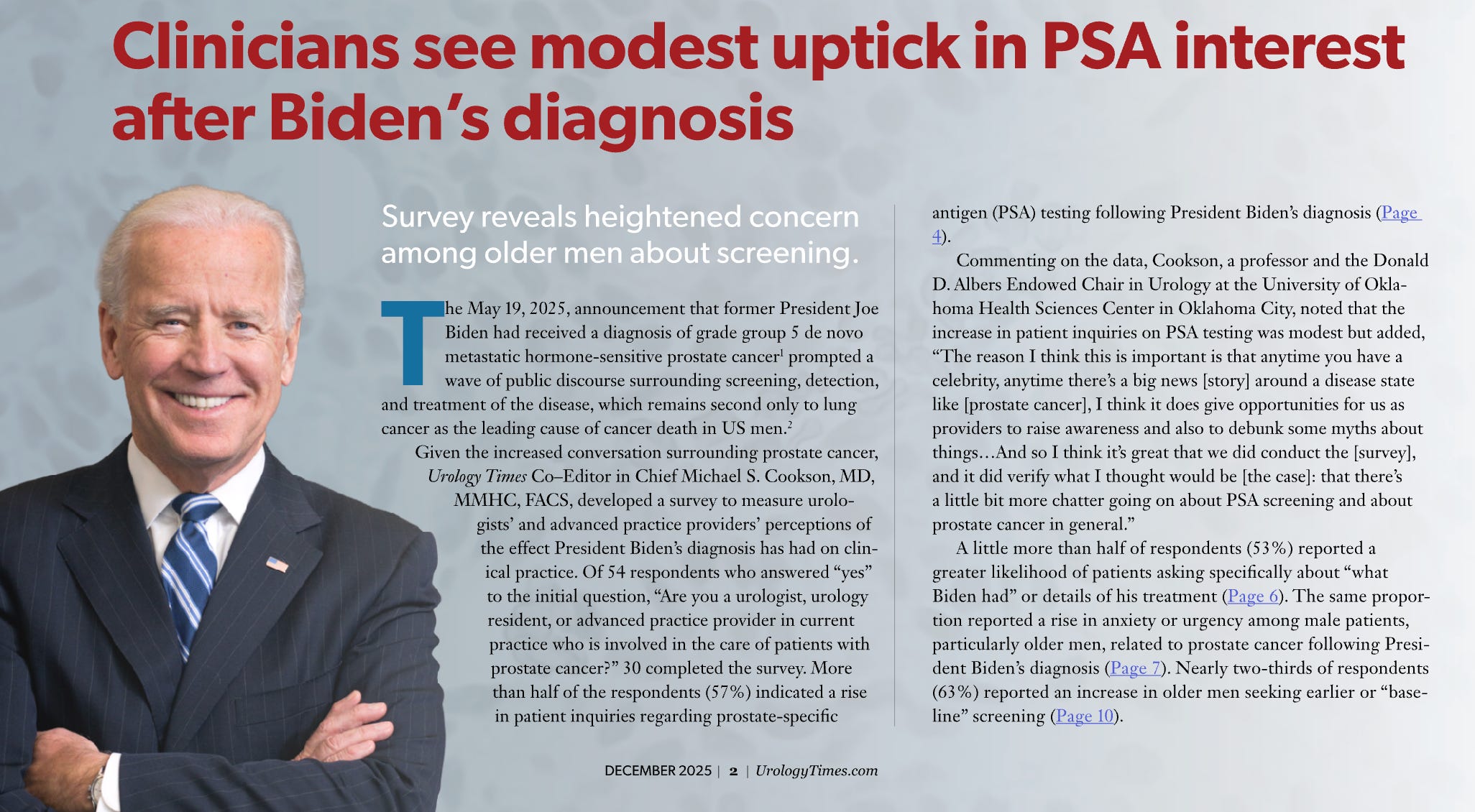
And finally, the story that brought prostate cancer into every living room in the US and beyond: ex-President Biden’s Gleason 9 diagnosis.
When the ex-president announced his high-risk, aggressive cancer in July, it did what decades of advocacy largely didn’t—made prostate cancer a national conversation, especially whether undiagnosed men should continue PSA screening into their 70s and beyond.
In a survey of clinicians, Urology Times found that Biden’s case led to a modest increase in patients asking about PSAs and increased anxiety about PCa among older men.
Moving forward as we start a new year, we need consensus on who can safely skip confirmatory biopsies.
The revolution in prostate cancer care is real. But as patient—and impatient—observers will tell you, the hardest battles are often the ones the doctors fight among themselves.
Come to The Active Surveillor webinar AS26 this Saturday
By Howard Wolinsky
I have received last-minute contributions that enable me to offer free attendance to Active Surveillance 2026, a review of AS news in 2025, and a look forward to this to a limited number of readers Saturday, Jan. 3, at 1-2:30 pm Eastern.
I’ll throw in a comped one-year subscription to The Active Surveillor.
The offer goes to the first 25 readers who write me—with subject line Free AS26. Write to me at howard.wolinsky@gmail.com on New Year’s Day.
Also, there is free entry to anyone who can’t afford a subscription. Again, just contact me at howard.wolinsky@gmail.com No questions asked, No limits.

Panelists include AS advocate Dr. Matthew Cooperberg, of UCSF; uropathologist Dr. Ming Zhou, of Mount Sinai in NYC; popular podcaster and naturopathic urologist Dr. Geo Espinosa; and MRI physicist Dr. Randy Jones, founder of Bot Image, which offers AI reads of MRIs.
This has been a big year for AS, with research showing that non-contrast biparametric MRIs were as effective as contrast multiparametric MRIs; for the first time, a biomarker (MyProstateScore2-AS) can help men on AS avoid biopsies; microultrasound is as safe and effective as MRIs; and more.
From ZERO Prostate Cancer—ask your Senators and Congressional rep to prioritize prostate cancer and active surveillance for low-risk.

As we welcome the New Year, let’s resolve to make a difference for the millions of Americans affected by prostate cancer. In 2025, our community faced significant challenges, including research funding cuts and threats to CDC cancer programs. Yet, we united to oppose these challenges, showcasing the power of our collective voice.
With 2026 on the horizon, Congress will soon make decisions that are crucial for prostate cancer patients. Your voice is essential in guiding them. Start the year by urging your members of Congress to prioritize prostate cancer patients by safeguarding research funding and expanding screening access. Together, let’s make 2026 a year of progress and hope!
Happy New Year,

ZERO Prostate Cancer
515 King Street · Suite 310, Alexandria, VA 22314
Don’t like these emails? Unsubscribe
In other news …
By Howard Wolinsky
For a another view of the top stories of 2025, check out The Scientist on cancer in general. Only one of its top picks relates directly to prostate cancer. It’s about the value of precursors to Vitamin K.
(BTW, my cancer nutritionist at UCSF only recommended Vitamin D3-K7 and a multi- vitamin.)
“Prostate cancer is often linked to harmful oxidative stress due to an imbalance between antioxidants and pro-oxidants. This prompted Lloyd Trotman, a molecular biologist at Cold Spring Harbor Laboratory to explore whether pro-oxidants, specifically menadione sodium bisulfate (MSB)—a precursor to vitamin K—could be a viable strategy to slow prostate cancer.
Urology Times listed its top 10 urology stories. It mentions FDA granting of has granted De Novo authorization for ArteraAI Prostate, establishing it as the first and only AI-powered software authorized to prognosticate long-term outcomes for patients with non-metastatic prostate cancer.
Here’s a top 10 for FDA approvals in 2025: https://www.cancernetwork.com/view/spotlighting-the-top-10-fda-oncology-approvals-in-2025
Famed uropathologist Dr. Jonathan Epstein to kick off ASPI’s 2026 series with a talk on decoding the mysteries of the pathology report
By Howard Wolinsky
Active Surveillance Patients International is starting 2026 off with a bang.
I have arranged for globally renowned uropathologist, Dr. Jonathan Epstein, to do a program explaining how prostate biopsy specimens are evaluated, what key findings on the pathology report mean, and why some important details may be missing or inaccurately reported. He also will discuss how differences in pathology interpretation can influence grading, risk assessment, and downstream treatment decisions. If you’ve ever felt unsure about understanding your prostate biopsy report or what questions to ask about missing details, this session will help.
The program is entitled, “Understanding Not Only What is Present on the Report, But Important Information that Could be Missing or Inaccurate.”
The session is scheduled for 12-1:30 pm Saturday, Jan. 24. 2026.
Register now: https://zoom.us/meeting/register/ALpboE3rQuSvmMX7rC0KHQ#/registration
This session is designed to help patients better understand their biopsy reports and feel more prepared to ask informed questions during clinical consultations—particularly for men considering or already on Active Surveillance.

(Dr. Jonathan Epstein)
Dr. Epstein recently launched Advanced Uropathology of New York: Global Consultation Services after nearly 40 years on the faculty at Johns Hopkins University School of Medicine. His work has shaped modern standards for prostate cancer grading, reporting, and clinical decision-making.