'The Biden Effect'--On PCa Information Seeking, Not Inflation
(Editor’s note: How about joining me Monday, May 18, at 2-3 p.m. Eastern at the meeting of the Sarasota Prostate Initiative. I will be presenting “How I Dodged the Knife and Found My Zen: 16 Years on Active Surveillance and Still Counting.”
Zoom link: https://us02web.zoom.us/j/86555718299#success
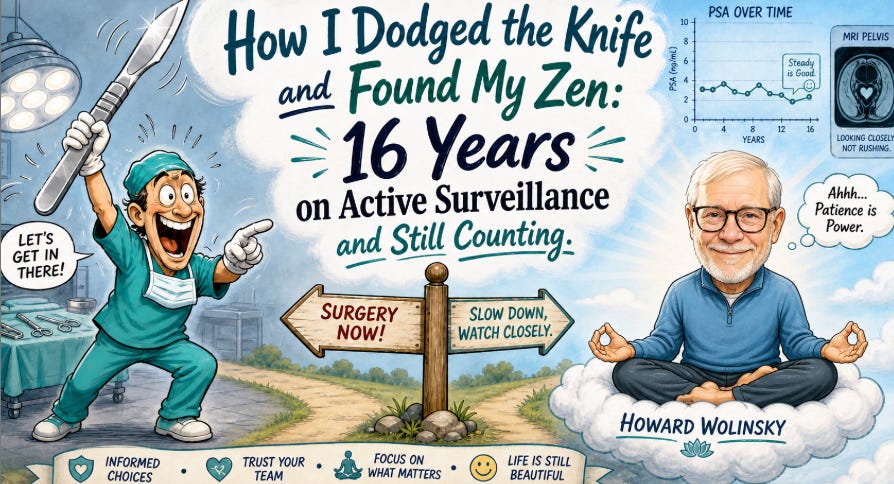
l’ll talk about my “origin story”: how I started with a panicked push for surgery, how I discovered Active Surveillance, and what I’ve learned over 16 years of living with low-risk prostate cancer.
Now to the news …HW.)
By Howard Wolinsky, Editor, The Active Surveillor
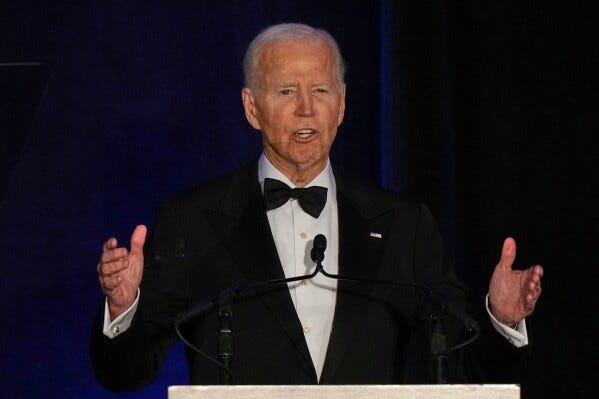
Former President Joe Biden’s prostate cancer announcement in 2025 appears to have pushed many Americans to look up basic and practical information about the disease online, according to a study presented by University of Oklahoma researchers at the American Urological Association annual meeting this week in Washington, D.C.
That is the main message from a new abstract — titled “Public Response to a Presidential Cancer Diagnosis.” The lead author is Max J. Bouvette, a third-year medical student at the University of Oklahoma. The senior author is Michael Cookson, MD, chair at Oklahoma and prominent urologic oncologist nationally.
What the Researchers Studied
The authors examined what happened after Biden announced on May 18, 2025, that he had aggressive prostate cancer. They used Google Trends — a tool that tracks how often people search for certain terms — and compared actual search activity with a statistical forecast of what traffic likely would have looked like without the announcement.
What People Were Searching For
Searches went up for all 14 prostate cancer terms the team studied. The biggest jumps were for “Joe Biden” and “prostate cancer,” but searches also rose for terms that matter directly to patients and families: “screening,” “signs and symptoms,” “survival,” “PSA testing,” “prostate exam,” and “prostate cancer treatment.”
The announcement did more than make people curious about one famous person. It pushed people toward basic health questions about testing, diagnosis, and what happens after a man is told he has prostate cancer. One early signal of how broad that curiosity ran: searches for “what is a prostate” spiked sharply in the hours after the news broke.
Senior author Cookson framed the bigger picture in a Urology Times editorial written in direct response to Biden’s diagnosis last year: “As clinicians, researchers, and advocates, this moment invites us to reflect on how far we’ve come — and how much further we must go.” He added:“President Biden’s strength in facing cancer adds a powerful voice to the broader conversation on men’s health.”
In a separate year-in-review piece several months later, Cookson offered a concise summary of what 2025 demonstrated: “If 2025 showed us anything, it is the power of combining scientific progress with public engagement.”
The ‘Celebrity Effect’ in Medicine
The Biden case fits a well-documented pattern. When a famous person discloses a serious diagnosis, public information-seeking can spike overnight — and sometimes stays elevated for months or years if that person remains engaged.
Dr. Jessica Gall Myrick, professor of health communication at Penn State, has spent decades studying this phenomenon. She told the American Heart Association: “Health disclosures by celebrities do matter, and we know this from decades of research across a lot of different health conditions and public figures. They absolutely do influence people.”
Dr. Seth M. Noar, director of the Communicating for Health Impact Lab at the University of North Carolina, adds: “Celebrity disclosures represent teachable moments. Searches for different health conditions often spike in the wake of these types of announcements. They cause people to think about these health issues, learn more about them, and in some cases change their behaviors.”
What makes the effect last, both researchers note, is not the celebrity but the story — and what the person does next. “It’s a narrative, a story that humanizes the condition in a way that very informational communication really doesn’t,” Noar says. “People remember it, and it can potentially be a touch point.”
Some benchmark cases:
Betty Ford and Nancy Reagan — the first ladies who made cancer speakable. The pattern goes back further than most people realize. When First Lady Betty Ford was diagnosed with breast cancer just weeks after Gerald Ford became president in 1974, she helped make talking about cancer less taboo. When Nancy Reagan’s breast cancer diagnosis came in 1987, the Los Angeles Times reported that “individuals throughout the country have been calling cancer physicians and information services in record numbers.” Ford was open about her case; Reagan sought privacy,
Magic Johnson, 1991. When NBA superstar Magic Johnson announced he had tested HIV-positive, calls to testing centers increased significantly in the days and weeks that followed. “That celebrity disclosure really helped people see there was a wider susceptibility to HIV,” Gall Myrick says. “People were more likely to say, ‘I need to think about my own risks.’ It was very powerful.” Johnson went further, becoming a long-term AIDS and safe-sex advocate — sustaining awareness well after the initial announcement.
Angelina Jolie, 2013 — the gold standard. After the actress published a New York Times op-ed revealing she carried the BRCA1 gene mutation and had undergone a prophylactic double mastectomy, BRCA testing rates jumped 64 percent in a Harvard-analyzed insurance database. In the UK, referrals to family-history clinics roughly doubled, with a two-and-a-half-fold spike in the two months immediately after her announcement. Jolie returned in 2015 with a second op-ed disclosing a preventive oophorectomy, producing another wave of public attention. Her effect lasted because it was proactive, medically specific, and intentionally sustained — and as Noar observes, “Angelina Jolie is often linked to the BRCA1 gene mutation” as a permanent cultural touchstone more than a decade later.

(They spoke out. Clockwise from upper left: Magic Johnson, Angelina Jolie, Betty Ford, and Sir Chris Hoy.)
Sir Chris Hoy: The Most Sustained Advocate of All
No current case better illustrates the difference between a one-time announcement and a life-defining mission than Sir Chris Hoy, the six-time Olympic gold-medal-winning British cyclist and one of the most decorated athletes in British history.
Hoy was diagnosed with stage 4 prostate cancer in September 2023, when doctors estimated he had two to four years to live. He went public in October 2024, immediately transforming his terminal prognosis into an advocacy platform. His regret was personal and direct: his father and grandfather both had prostate cancer, and had Hoy himself been screened earlier, his disease might have been caught at a curable stage. His message was equally direct: “With a PSA test, you’re in and out of the doctor’s in five minutes. It’s easy, it’s simple, it’s painless, and it could save your life.”
The awareness numbers were staggering. In the six months after he went public, NHS referrals for urological cancer rose by nearly 5,000 — described by experts as “remarkable.” Prostate Cancer UK’s risk checker visits jumped 77 percent. His “Brief Check” campaign had 180,000 men complete the checker in just 40 days, raised £155,000 for research, and prompted 1 in 5 high-risk men to say they would see a GP.
The political impact was just as significant. Hoy’s sustained advocacy helped push the question of a national prostate cancer screening program into formal UK policy channels. In November 2025, the UK National Screening Committee (NSC) recommended against routine PSA screening for most men — including Black men and those with a family history — concluding that overdiagnosis harms would outweigh benefits.
The decision stunned campaigners. Hoy’s reaction: “I was quite astonished. I can’t believe that the answer to this situation is to sit on your hands and do nothing.”
At the same time, Hoy announced in late March 2026 that he had personally helped launch the Scottish Prostate Cancer Initiative, targeting free PSA testing for 25,000 men, with all resulting data fed directly into the national evidence base. “Early diagnosis saves lives — that is the key takeaway,” he said at the initiative’s launch.
Most recently, in late April and early May 2026 — now living more than two and a half years past his diagnosis — Hoy shared a cautiously hopeful health update: “It’s going relatively well, and I’m just continuing with life. It’s important to find ways to appreciate the present and trust those working on these remarkable innovations. There may be groundbreaking treatments just around the corner if you can hold on.” He has expressed particular hope in an immunotherapy trial drug showing “remarkable” early results in advanced prostate cancer, and he is closely watching AI-assisted drug development as a potential path to extended survival. He has not yet been able to access the specific drug but remains hopeful that it or something similar will become available.
Do Pols Often Go Public With Their PCa Diagnosis??
The short answer: not historically, but the culture is shifting.
For most of American history, presidents and politicians concealed serious illnesses. President Grover Cleveland had oral cancer surgery in 1893 aboard a private yacht to avoid public knowledge. Woodrow Wilson suffered a stroke in 1919 that left him incapacitated for nearly two years and left his wife in charge.
There is still no legal requirement for presidents or candidates to disclose their health.
Senator John McCain’s 2008 release of 1,173 pages of medical records — covering multiple melanoma diagnoses — was described at the time as “unprecedented in the history of presidential campaigns” and set a new transparency standard. But his disclosure was driven primarily by political necessity rather than health advocacy; there is no documented “McCain Effect” in skin cancer screening research, because he did not sustain a public education role afterward.
Biden’s case carried an additional complication: questions arose almost immediately about whether his White House had been forthcoming about his overall health during his presidency, renewing a public debate about the standards — and limits — of presidential health disclosure.
The Key Variable: Passive Disclosure vs. Active Advocacy
The research makes a clear distinction. A one-time announcement produces a brief spike — typically days to two weeks — in searches, hotline calls, and media attention. Sustained behavior change requires the person to keep showing up.
Myrick identifies what makes a disclosure educationally effective: “The most effective celebrity disclosures are frequently the ones that tell a compelling story and include clear steps people can take to apply lessons the celebrity learned to their own health situation. People are more likely to take action when they feel confident and capable.”
And today’s multiplatform environment amplifies that effect — but only if the person keeps feeding it: “We know from research that seeing messages more than once can be impactful. Often it’s not just one billboard or one commercial that impacts behavior; it’s the drip drip drip over time.”
Biden made no sustained follow-up effort. Hoy has made it his life’s purpose, with policy and scientific consequences that will outlast the initial announcement by years.
Why This Matters to Patients
When a well-known person talks about prostate cancer, there is a brief — but extendable — window when men and their families may be more willing to learn the difference between low-risk and high-risk disease, between screening and diagnosis, and between immediate treatment and careful monitoring.
That matters for readers of The Active Surveillor because too many men still hear the words “you have prostate cancer” and assume they must rush into treatment. For men with truly low-risk disease, Active Surveillance can often be the better path: regular PSA tests, follow-up MRI scans, and sometimes repeat biopsies, with treatment held in reserve unless the cancer shows signs of becoming more serious.
I’m still waiting for a public figure, like a president, a king, a movie star, a rocker, or another high-profile person, to reveal that he’s on surveillance. They must exist, after all, lower-risk prostate cancer cases make up the majority of men diagnosed each year. And AS is the preferred cancer management strategy.
Biden’s prostate cancer was aggressive and metastatic — Gleason Grade Group 5, spread to bone. Hoy’s case is terminal stage 4. Neither is an Active Surveillance story. But the public response to both disclosures shows how a high-profile case can open the door to broader education, including when not treating right away may be the safest and wisest choice.
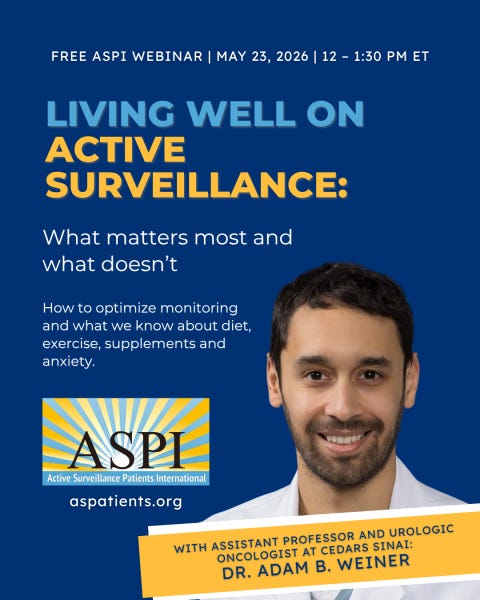
Join Me. Don’t be bashful: Attend ASPI’s Webinar Featuring Dr. Adam B. Weiner on Living Well With AS
On Saturday, May 23, 2026, at noon Eastern, Active Surveillance Patients International will host Adam B. Weiner, MD, a urologist at Cedars-Sinai, for a program titled, “Living Well on Active Surveillance: What Matters Most (and What Doesn’t).”
REGISTER HERE: https://zoom.us/meeting/register/VfFFjirZSbyHoc8cNIMZJQ#/registration
For men on Active Surveillance, one of the continuing challenges is separating what truly deserves attention from what may only add anxiety. Weiner will discuss the key components of Active Surveillance, what patients can do to optimize their monitoring, and what is currently known about the role of diet, exercise, and supplements in prostate cancer care.
He will also address the uncertainty that can accompany Active Surveillance and offer practical guidance on what matters most — and what may not warrant as much worry.
Questions are welcome. Patients may submit them in advance to contactus@aspatients.org. There will also be a dedicated time for live Q&A following the presentation.