Update: UK 'Rationing' Prostate Screening and Waits on TRANSFORM to Include More Black Men

By Howard Wolinsky, Editor, The Active Surveillor
England is moving toward a targeted prostate cancer screening program, not a screening program for all men.
Under the plan backed by the UK National Screening Committee (NSC), the National Health Service, the UK’s national health plan, and now endorsed by the Health Secretary for England, would offer a PSA blood test every two years only to men ages 45 to 61 who carry a pathogenic BRCA2 variant and have a family history of breast, ovarian, pancreatic, or prostate cancer.
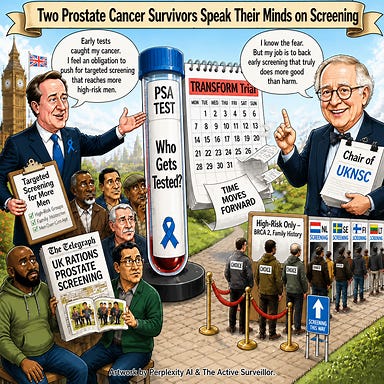
For patients and families, the message is simple: this is a high‑risk program for a very small group – “a few thousand” men each year – not a green light for broad PSA screening.
(Artwork by Perplexity AI & The Active Surveillor.)
In England, Health Secretary James Murray has now accepted the NSC’s advice and says he is “following the science,” emphasizing that mass PSA testing “would likely cause more harm than good” and that only a relatively small, very high‑risk group should be offered regular screening for now. At the same time, he has announced funding to expand the much‑anticipated TRANSFORM trial to specifically include more Black men, framing this as the route to understanding which screening approach works best for those at highest risk. (See story below.)
The committee says it is trying to avoid repeating the old cycle of widespread PSA testing, overdiagnosis, and overtreatment.
The government’s equality impact assessment notes that PSA is imperfect, with about three‑quarters of men with a raised PSA not having cancer and a substantial minority of men with a “normal” PSA still harboring prostate cancer, creating risks of both overdiagnosis and false reassurance. Its modeling estimates that for every 1,000 men offered screening, about 2 lives may be extended, but up to 20 men may be overdiagnosed and about 12 may undergo unnecessary treatment. The report also details the harms that drive the NSC’s caution.
After radical prostatectomy, nearly three‑quarters of men at six months have difficulty controlling their bladder, 19% have moderate to severe urinary incontinence, 3% have moderate to severe bowel problems, and 66% report moderate or severe erectile dysfunction. After radiotherapy, 38% have bladder‑control problems, 6% have moderate to severe urinary incontinence, 5% have moderate to severe bowel impacts, and 48% report moderate or severe erectile dysfunction.
As the UK NSC summary puts it, “the main harms of prostate cancer screening include incontinence and erectile dysfunction in men who do not need treatment,” and in its view broad screening still exposes too many men to these harms for too little survival gain. That logic has produced very tight eligibility lines. The NSC does not recommend screening all men, Black men as a group (despite high incidence and death rates), men with family history alone, or men with BRCA1 variants. It recommends screening only the BRCA2‑plus‑family‑history group because that is where it judges “the evidence is only strong enough” to show benefits outweigh harms.
According to Dr Ian Walker, Cancer Research UK’s executive director of policy, “screening should only be introduced when the benefits outweigh the harms, including unnecessary and invasive overtreatment, and right now, the evidence is only strong enough to screen men aged 45 to 61 with BRCA2 gene changes and a relevant family history.” The pathway is also deliberately modern: PSA, then mpMRI, then biopsy only when indicated, rather than the old “PSA straight to biopsy” model.
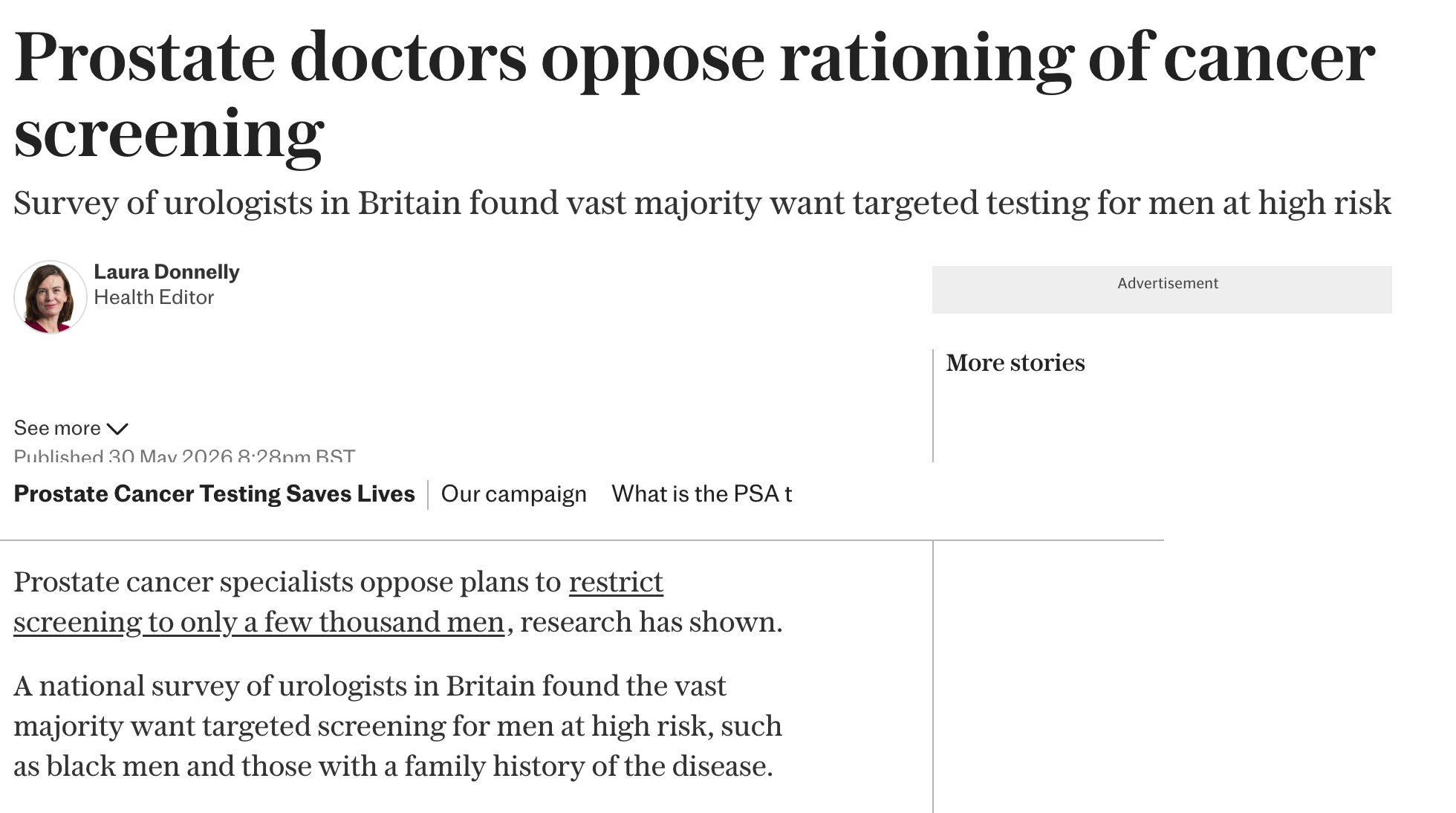
This is where the policy begins to look, to critics, less like precision and more like rationing.
The BBC highlighted that only “a few thousand” men with a dangerous genetic variant and family history will be screened, while “no screening is advised for other high‑risk male demographics, such as Black men or men with a familial history of prostate cancer.”
Prostate Cancer Research warned that “Black men and men with a family history – among the groups at highest risk of the disease – are still being left out,” calling the NSC decision “profoundly concerning” because “we know early diagnosis saves lives, yet the very men most likely to benefit from earlier detection are being told to wait.” Prostate Cancer UK has said that a recommendation limited to BRCA2 carriers “will be deeply disappointing” for many men and “risks entrenching inequalities” rather than reducing them.
Scientists themselves are not speaking with one voice.
The Science Media Centre quoted one expert saying the NSC’s decision “will be disappointing for many men,” but that “the harms unfortunately outweigh the benefits” for population‑wide screening with current tests.
Sir Mike Richards, the NSC chair and a prostate cancer survivor, has insisted that the committee is “committed to an evidence‑based approach,” arguing that “whole population screening may lead to a small reduction in prostate cancer deaths, but very high levels of overdiagnosis mean the harms would outweigh the benefits.”
Other researchers counter that MRI, risk‑stratified pathways, and new blood tests change that balance, and that the committee’s modeling is now too conservative for groups such as Black men and men with strong family histories.
Into this debate have stepped politicians and high‑profile patients who know the stakes firsthand.
Former prime minister Lord David Cameron, whose cancer was found in 2025 after a PSA test, MRI, and biopsy led to focal treatment, has said he felt “an obligation” to speak publicly so other men come forward. He has called for “a targeted screening program” that reaches more high‑risk men and warned that “we’ve really got to think about this, talk about it and, if necessary, act on it,” aligning himself with charities who want a broader risk‑based approach.
Front‑line specialists are now openly siding with the critics. As The Telegraph reported, “most prostate cancer specialists believe the recommendation is outdated,” with experts calling it “stuck in the past.” In a survey of more than 200 urologists led by Imperial College London, 67% disagreed with the decision not to screen all Black men, while 64% said men with a family history should be offered tests.
Previous research cited in the same coverage suggests that more widespread screening “could prevent approximately 1,500 deaths a year,” strengthening the case that the NSC has under‑estimated potential benefit. Researchers said they launched the survey because “the views of clinicians directly involved in diagnosing and treating prostate cancer are not routinely captured” during the decision‑making process.
While England has set out its preferred model, the NSC recommendation still has to be formally accepted or rejected by health ministers in Scotland, Wales, and Northern Ireland, with each health secretary deciding whether to adopt targeted screening and how to implement it in their own system.
Much now rides on TRANSFORM, the £42 million NIHR–Prostate Cancer UK TRANSFORM trial that has been billed as “the most ambitious prostate cancer screening trial in decades,” designed to test smarter, genetic and MRI‑based screening in men from diverse ancestries and, crucially, to ensure Black men are included.
As Prof Ros Eeles, co‑lead of TRANSFORM and Professor of Oncogenetics at The Institute of Cancer Research, London, and Consultant Clinical Oncologist at The Royal Marsden Hospital, put it, “TRANSFORM is a game‑changer because it will allow us to rigorously test genetic markers on a large scale in men from diverse ancestries,” potentially identifying “men at risk of aggressive cancer who will need regular tests, while sparing men at low‑risk from having unnecessary biopsies and treatments.”
Until those data arrive, the UK will move ahead with a tightly rationed screening offer for a few thousand BRCA2 carriers, while much of Europe presses forward more broadly. With Murray now signed up to the NSC’s narrow eligibility but promising expanded research participation for Black men, the debate over how far PSA‑based screening should go – and who gets access first – is unlikely to fade.
What’s this mean for U.S. patients?
For American men at higher risk—Black men, men with BRCA2 or other germline variants, and those with a strong family history—the UK debate carries a more personal message: do not wait for perfect policy to protect you.
England is telling its highest‑risk groups that they deserve better evidence, but that they will have to live with today’s uncertainty while TRANSFORM runs.
In the U.S., the lack of a national screening program means high‑risk men are already in a de facto “do‑it‑yourself” system, where PSA testing, MRI access, and genetic counseling depend on insurance, geography, and how hard they push.
The practical takeaway is that men at clearly elevated risk should be proactive—asking about earlier PSA, MRI‑based pathways, and Active Surveillance options—rather than assuming that a cautious or ambiguous guideline means “do nothing.”
Invited to Trials, Denied Screening: Black Men and the UK’s Prostate Cancer Gap—As ‘Culture War’ Rages
By Howard Wolinsky, Editor, The Active Surveillor
Thousands more Black men in the UK will soon be invited to join a major prostate cancer screening trial. At the same time, the government has decided not to offer routine PSA testing to all men – including those Black men who face the highest risks.
Health Secretary James Murray says he is “following the science” by accepting advice from the UK National Screening Committee, which concluded that mass PSA testing would likely cause more harm than good, because the test can miss some cancers and trigger unnecessary biopsies and treatment in others. Instead, only a relatively small, very high‑risk group – men with a BRCA2 gene mutation and a strong family history of certain cancers – will be offered regular screening every two years.
For Black men, who are more likely to get prostate cancer and more likely to die from it, that decision feels like a mixed message. The government is expanding research focused on them, while refusing to offer them routine testing. Campaigners argue that high‑risk communities are being asked to wait for better evidence while living with higher odds of late diagnosis and death.
What is changing – and what isn’t?
The government has announced £20m for prostate cancer research and treatment and a significant expansion of the TRANSFORM trial, which is testing better ways to find prostate cancer early. The second stage of TRANSFORM will invite Black men aged 45–74, across the UK, to take part if they haven’t had a PSA test or prostate MRI in the last five years. That should mean thousands more Black men are offered some form of testing through research.
Supporters of the policy say this will help answer a crucial question: what kind of screening actually works best for men at highest risk, including Black men, without causing the harms seen with blanket PSA testing.
Critics counter that, in the meantime, those same men remain outside any systematic screening program. They see the decision as one that locks existing inequalities in place rather than actively correcting them, especially given the longstanding concerns about under‑diagnosis and delayed diagnosis in Black communities.
Community advocates and patient groups also point to a frustrating process. They say attempts to engage with the screening committee were brushed aside, and that the final recommendation takes insufficient account of lived experience and structural inequities. From their perspective, the bar for “proof” has been set higher for interventions that might benefit Black men than for decisions that maintain the status quo.
Deputy Prime Minister David Lammy, who has two brothers living with prostate cancer, has stressed that improving research participation among Black men is an essential part of closing the mortality gap. The hope from policymakers is that a larger, more diverse TRANSFORM trial will eventually deliver screening strategies tailored to those at highest risk. For many patients and families, however, the immediate reality is that the UK is willing to expand research in Black communities, but not yet willing to offer population‑wide PSA screening – even to the groups who stand to lose the most from missed cancers.
When evidence becomes a culture‑war weapon
This debate is no longer just a technical argument about test performance. It has been pulled into the UK’s wider culture wars, with some right‑leaning politicians and media outlets portraying a risk‑based, evidence‑driven strategy as a “two‑tier” system that discriminates against men—and particularly against white men.
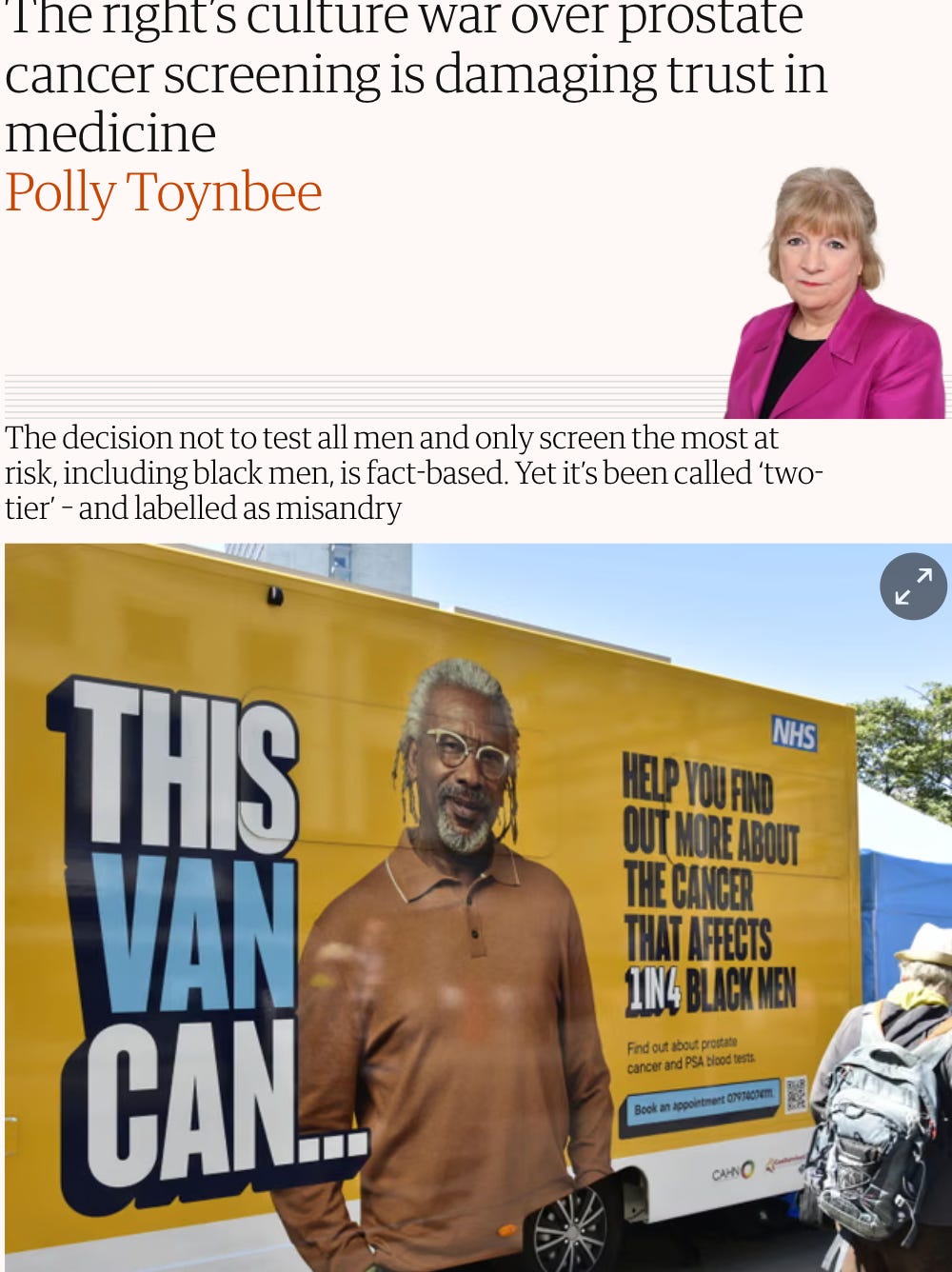
In a recent column in The Guardian, Polly Toynbee warns that “the right’s culture war over prostate cancer screening is damaging trust in medicine,” arguing that the decision not to test all men, and to focus instead on those at highest risk (including Black men), is grounded in data on over‑diagnosis and overtreatment, not in “misandry” or anti‑male bias. She points out that for every 1,000 men screened with PSA, only a very small number may benefit, while many more are told they have a cancer that would never have threatened their lives, exposing them to surgery or radiotherapy with life‑changing side effects.
In the UK prostate screening debate, some critics have accused the National Screening Committee of “misandry,” discrimination against men, claiming that refusing mass PSA testing while maintaining breast screening for women turns men into “second-class citizens.”
In her Guardian column, Polly Toynbee notes that this rhetoric ignores the very different evidence on benefit and harm for the two tests and instead reframes an evidence-based, risk-stratified policy as anti-male bias.
She also highlights how tabloids refer to scientific advisers as “health boffins” – British slang for scientific and technical experts – a label she calls patronizing because it paints them as clever but clueless lab geeks and suggests that their recommendations are out of touch with “common sense.” In Toynbee’s view, combining charged words like “misandry” and “boffins” turns a nuanced discussion about overdiagnosis and side effects into yet another culture-war story, undermining public trust in medicine rather than helping men understand the real trade-offs.
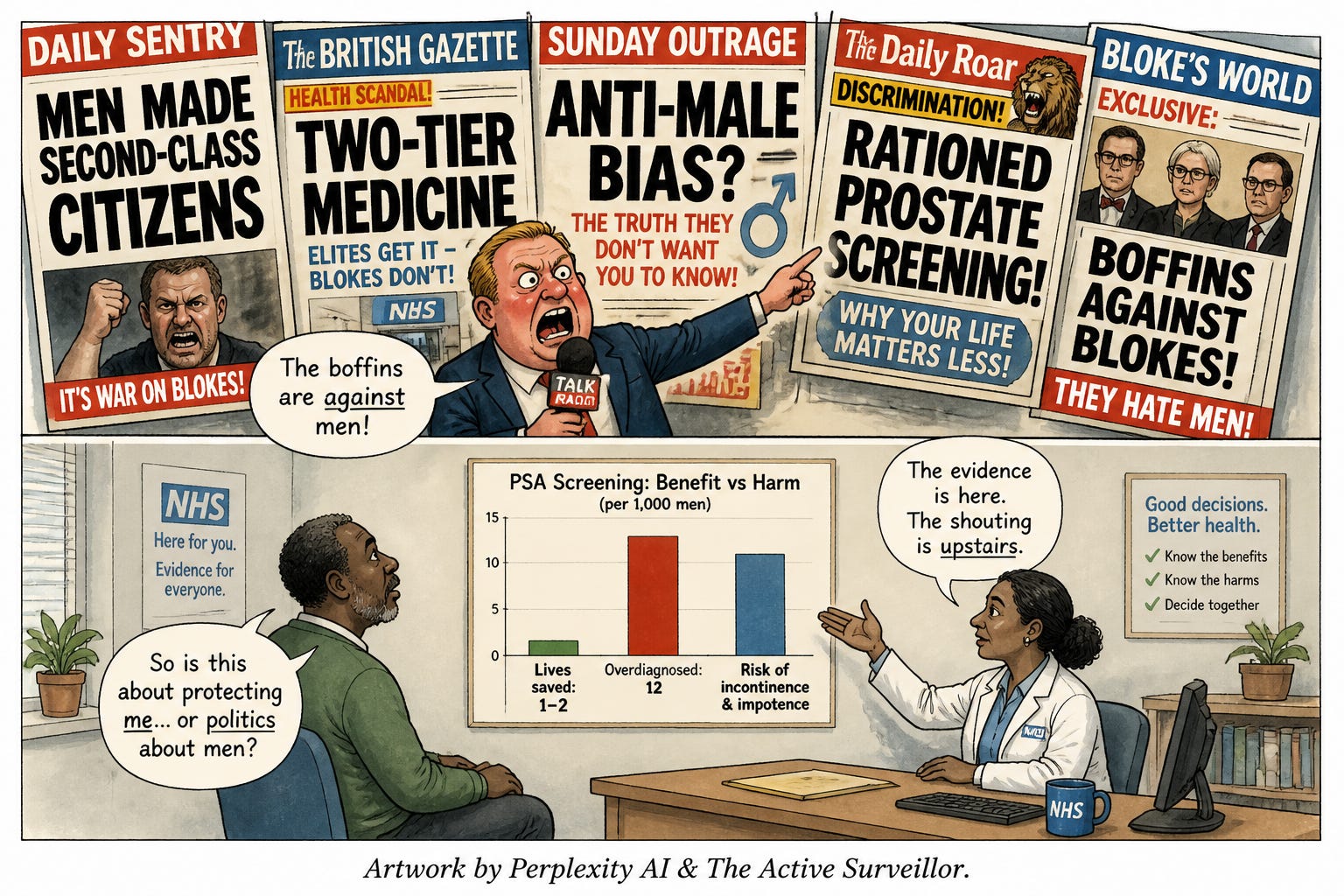
Toynbee also notes how commentators have seized on the fact that Black men are being proactively recruited into trials while universal PSA screening is rejected—using it to stoke anger about “special treatment” and to contrast prostate cancer with breast screening, without acknowledging the very different balance of benefit and harm between the two tests. In her view, talking down science in this way doesn’t just confuse men about PSA; it risks the same kind of long‑term erosion of trust that followed the MMR vaccine scare.
You can read her column here:
“The right’s culture war over prostate cancer screening is damaging trust in medicine” – Polly Toynbee, The Guardian.
For Black men in the UK, all of this adds another layer. They are being told, on the one hand, that their higher risk justifies special efforts to bring them into research—and, on the other, that there still isn’t enough evidence to justify a dedicated screening program for them. When that scientific caution is then framed in the media as either “anti‑male bias” or “two‑tier medicine”, it becomes even harder to build the trust needed to make risk‑stratified screening work for the very communities it is supposed to help.
Check Out ‘This Guy’s Guide: The No-BS Health Report for Men 50+’
By Howard Wolinsky
I appreciate your subscription to The Active Surveillor. But there’s more to men’s health than the finicky prostate and its myriad issues.
In time for June’s Men’s Health Month and Father’s Day, I’m launching “This Guy’s Guide: The No-BS Health Report for Men 50+.”
In This Guy’s Guide, I will cover the full gamut of topics that concern us men over 50: wellness, exercise, diet, sleep, hypertension, BPH, heart disease, cancer, etc. Let me know what you think I should cover: howard.wolinsky@gmail.com
I aim to bring you the facts, often with a lighter touch, once a month.
Get a preview here: https://thisguysguide.substack.com/publish/post/196160545
I hope you will sign up for a free subscription, try it, and upgrade to a paid subscription if you’d like to support my work.
No pressure. No BS, either.
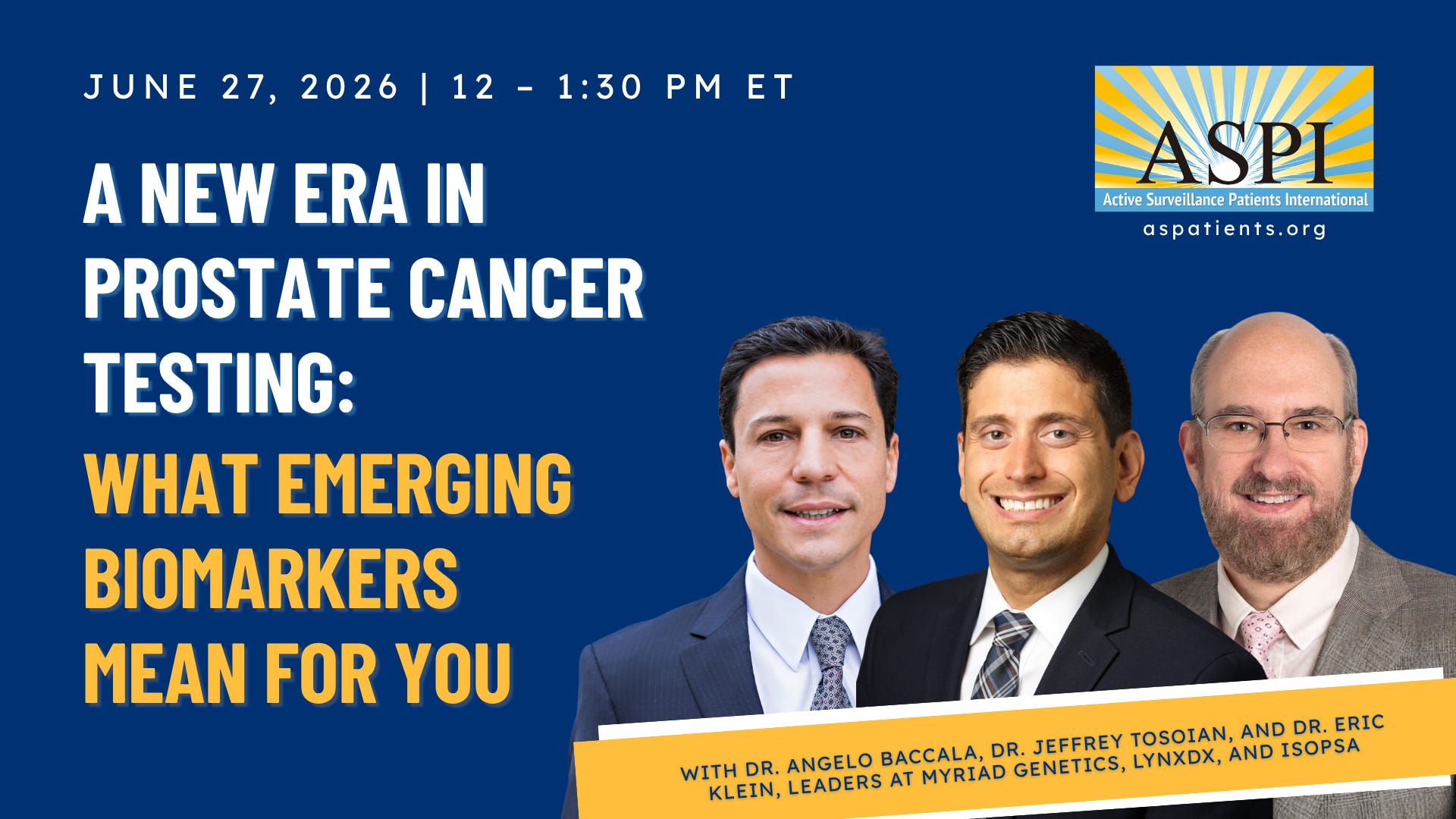
Join Us: Prostate Cancer Testing: What Emerging Biomarkers Mean for You
By Howard Wolinsky, Editor, The Active Surveillor
An expert panel hosted by Active Surveillance Patients International (ASPI) will be held on Saturday, June 27, from noon to 1:30 p.m. to explore how new prostate cancer biomarkers can guide choices between Active Surveillance and definitive treatment.
Speakers include
Dr. Angelo A. Baccala Jr., MD, FACS, MBA, Chief, Division of Urology, and Deputy Physician-in-Chief, Innovation, Lehigh Valley Health Network. He will discuss the growing role of biomarkers in prostate cancer care, including Myriad Genetics’ new Prolaris + AI platform and how it may help men and their clinicians weigh surveillance versus treatment.
Dr. Jeffery Tosoian, Associate Professor of Urology at Vanderbilt, will review MyProstateScore2‑AS, the first biomarker specifically validated for men on Active Surveillance and its potential to refine who can safely continue to defer treatment. He helped develoip the test.
Dr. Eric Klein, urology chair emeritus at Cleveland Clinic, will highlight IsoPSA, another promising biomarker designed to better distinguish clinically significant cancer and reduce unnecessary biopsies. He helped develop the test.
For background on these tests, see recent coverage of MyProstateScore2‑AS, IsoPSA, and the broader biomarker market in Active Surveillance.
To attend, go to https://aspatients.org/event/a-new-era-in-prostate-cancer-testing/, scroll down, and click the Register button for a front‑row virtual seat.
Patients are encouraged to submit questions in advance to contactus@aspatients.org. There will also be dedicated time for live Q&A after the presentations. If you can’t join live, register anyway, and you’ll receive a notice when the video is posted.
The strongest possible condemnation should be reserved for things like selling cigarettes in pediatric wards, replacing parachutes with positive thinking, or serving English beer at room temperature and calling it a feature. What England is doing is not madness. It is caution. The real question is whether it is cautious to the point of paralysis.
The devastating critique is not that policymakers are evil, indifferent, or stupid. It is that they remain trapped in a prostate cancer debate that often sounds as though it is still taking place in 1998. Their entire argument rests on a legitimate observation: PSA testing led to overdiagnosis and overtreatment. This is true. Men were diagnosed with cancers that may never have harmed them, and some suffered unnecessary side effects. Nobody disputes this.
The problem is that medicine has not remained frozen in amber while the committee continued studying spreadsheets.
The policy reads like a government document written by people who have become so terrified of treating men unnecessarily that they have become comfortable not finding them at all.
Consider the logic. A 55 year old Black man with a father and brother who had prostate cancer is apparently not high risk enough. A man with a strong family history but no BRCA2 mutation is apparently not high risk enough. But a man who checks a very specific genetic box enters the sacred circle of approved concern. This is precision medicine carried to the point of absurdity.
Imagine applying the same standard elsewhere. "We recognize that your house is on fire, sir. We can see flames emerging from the windows and smoke pouring from the roof. However, our models indicate that only houses with red front doors and Labrador retrievers statistically benefit from immediate firefighting. We are funding a promising study regarding blue doors. Results expected sometime after your living room has collapsed."
The entire exercise reveals a peculiar bureaucratic instinct. When confronted with uncertainty, institutions often conclude that the safest action is inaction. If ten men are harmed by overtreatment, that is measurable and visible. If ten men die because their cancer was never found early enough, that harm is dispersed, delayed, and easier to ignore.
Politically, overtreatment creates victims with names. Undertreatment creates statistics.
The irony is that the very advances designed to solve the old screening problem are largely ignored in the argument. MRI was not part of widespread screening pathways thirty years ago. Active Surveillance was not nearly as accepted. Genetic risk models were primitive. Risk stratification was crude. Yet many of the assumptions driving today's decisions are still built on data from an era when the internet made screeching dial up noises and grown adults believed fax machines represented the future.
Meanwhile, specialists who spend their lives diagnosing prostate cancer increasingly seem to be saying the same thing: perhaps the balance has changed.
When two thirds of practicing urologists disagree with the policy, it may be worth asking whether the people treating the disease know something that the policy model does not.
The most troubling aspect is not the exclusion of average risk men. Reasonable people can debate that. It is the exclusion of groups that almost everyone agrees are at elevated risk. Black men. Men with strong family histories. Men whose risk is obvious without requiring a genetic sequencing report thick enough to stun a badger.
England's position essentially says: "We know you are at higher risk. We simply do not yet possess sufficient certainty to justify looking."
Cancer, unfortunately, has never required certainty before proceeding.
There is another uncomfortable truth here. Every healthcare system rations. Canada does. Britain does. The United States does, although Americans prefer to call it "insurance coverage decisions" because that sounds less alarming. The question is not whether rationing exists. The question is whether we are honest about it.
When a government says, "We cannot justify screening broader groups because evidence remains incomplete," that may be scientifically defensible. When critics hear, "We cannot justify screening broader groups because the costs, complexity, and consequences would be substantial," they may also have a point. Both statements can be true simultaneously.
What makes the policy vulnerable is that it feels less like a confident embrace of modern evidence and more like a holding pattern. A nation that invented radar, penicillin, and the industrial revolution has essentially announced that it would like several more years to think about whether high risk men should receive more screening.
Cancer, displaying its usual lack of respect for committee schedules, is unlikely to wait.
The real scandal is not that England has chosen a narrow screening program. The real scandal would be if the ongoing trials confirm that broader risk based screening saves substantial numbers of lives and policymakers spend another decade debating whether those lives are worth the inconvenience of finding them. That is the danger of becoming so determined to avoid one kind of mistake that you institutionalize another.
Hans so well said, especially, "What makes the policy vulnerable is that it feels less like a confident embrace of modern evidence and more like a holding pattern.", and supports the Imperial College London, "....views of clinicians involved in diagnosing and treating prostate cancer...not routinely captured during the decision-making process." In your words, Hans, coupled with Howard's continued commitment to us, one can no longer claim ignorance of the controversy, for the issue of "bullied acquiescence" written about in the Journal of Clinical Ethics is front and center, RIPE within the profession! To those wo have not shown support for this blog not in the medical field, where else would you learn of research directly bearing on your care?